
Throughout history, there have been instances where a person or a group of people have attempted to reshape societal and individual views by emphasizing human dignity, reason, and individualism. This can be argued as demonstrating humanism, which Dirk Messner provides an Enlightenment-era explanation as “rational, autonomous, and communicative subjects with natural rights” in his article Redefining and Renewing Humanism in the Digital Age [Opinion]. With the current state of today’s technology, the continuing developments of generative artificial intelligence (genAI) is not excluded from this societal reshaping.
In an effort to instill human values and dignity into the technology world, many people — including those influential in Silicon Valley — are gravitating toward humane technology and the positive impact it can have on the future of AI. While many have warned of the doomsday that is ahead, three co-founders of the Center for Humane Technology (CHT), Tristan Harris, Aza Raskin, and Randima Fernando, have decided to attempt to equip American society with the knowledge and resources to prevent the impending doom. The nonprofit organization’s About Us page states the center works to lead “a comprehensive shift toward technology that strengthens our well-being, global democratic functioning, and shared information environment.”
The cofounders participate in and provide various resources to educate both consumers and business leaders, so everyone can collectively make more conscious decisions concerning social media and AI. These cofounders do not condemn the use of AI, but embrace it. Their arguments are not against technology but more against inhumane and selfish practices. The knowledge they share is not just ideas, they engage in the practices themselves. Cofounder Aza Raskin takes the idea of humanism a bit further by wanting to connect with the natural world in hopes of fighting climate change, as Billy Perrigo states in his TIME article Aza Raskin Tried to Fix Social Media. Now He Wants to Use AI to Talk to Animals. The idea of taking important values into consideration for future generations is considered environmental humanism, which falls in line with the concept of longtermism. Raskin goes even further into post-humanism by experimenting with AI to talk with animals.
The Center for Humane Technology is an organization founded by members who once contributed to what is now the norm in social media for both businesses and consumers. This report will observe what humane technology is and its relevance to the center, as well as dive deeper into how the center’s approaches with AI reflect the cofounders’ ideas with the concepts of humanism to include environmental humanism and post-humanism.
What is humane technology?
The website ethical.net mentions that humane technology is a concept that focuses on the well-being of individuals in a society as well as advocates for ethical uses of AI and accurate online content. This means that the user is not exploited, and ethical uses of technology are a social responsibility that could include ways to improve society and quality of life.
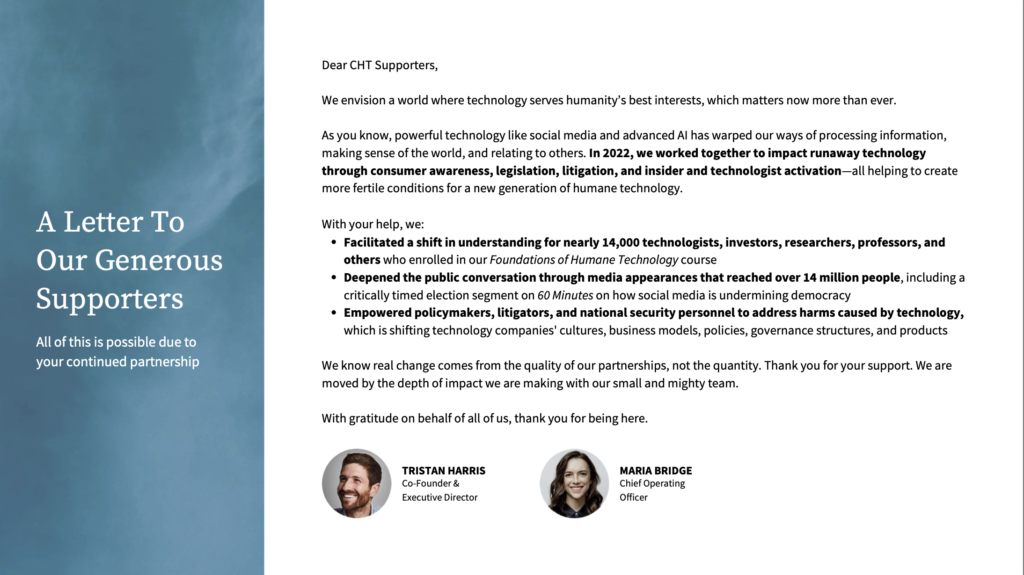
The CHT’s website’s About Us page has a section that highlights the impacts the organization has made in the last year. The goals and accomplishments for the year 2022 demonstrate how the nonprofit focuses on and promotes the well-being of individuals and the ethical uses of AI. One of the accomplishments includes engaging in consumer awareness, legislation, and litigation to lay the groundwork for a new generation of humane technology.
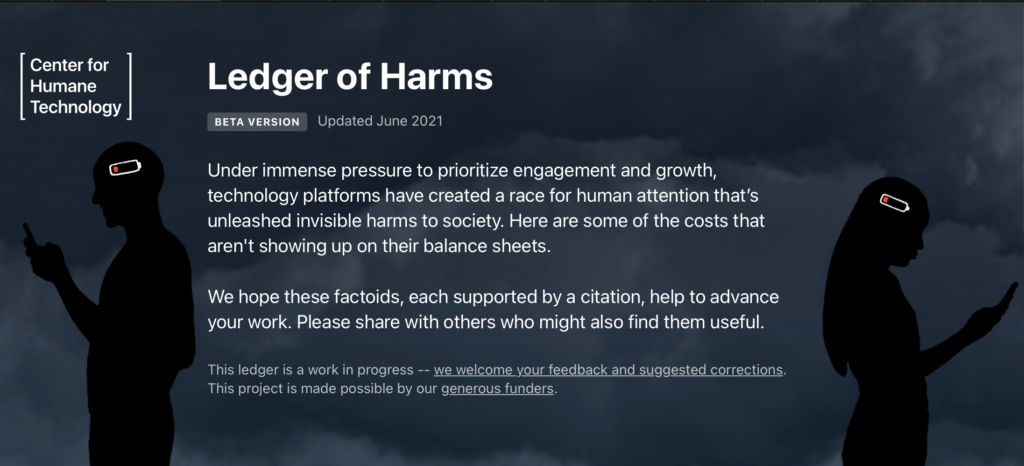
Though these accomplishments boast a positive move forward, is it enough? Junaid Qadir, Mohammad Qamar Islam, Ala Al-Fuqaha mention in their article Toward accountable human-centered AI: rationale and promising directions the CHT’s list of harms an AI-driven society poses, which includes physical and mental health; misinformation of politics and elections; and systemic racism. The authors go on to state that while the CHT does list these outcomes and possible solutions, AI development is still dominated by certain demographic groups, thus reflecting certain stereotypes and biases. The list has not been updated since 2021, leaving one to question if these harmful outcomes are being ignored. Other harmful outcomes are deepfakes and the government using AI for warfare, which as Connor mentioned in his section on Digital Security, has already seeped into civilian life by breaching the security we depend on in everyday life when browsing the internet.
To exacerbate the fear of what could happen if these concerns are not paid more attention to, Messner explains in Redefining that data collection, public opinion, and democratic elections can be manipulated if access to communication infrastructures is left without restrictions.
A reason for the pause in looking further into the underrepresented in technology could be the challenges of implementing the solutions. On one end, ethical.net explains that technology businesses are not heeding the center’s concerns, such as the concern for misinformation in politics, by continuing to show political ads on social media. On the other end, Qadir et al. explain that while there are plenty of efforts made to define ethics in AI, no one has figured out how to easily adopt and apply them.
This difficulty brings home a humanistic example of the CHT putting humans at the forefront of humane technology since it is the people who need to efficiently receive and understand the guidelines in order for them to be carried out.
Humanism
The executive leaders of the CHT have created an organization that produces content emphasizing ethical decision-making based on concern for human beings. This approach is in line with Understanding Humanism’s idea of a humanist’s actions. The site also states the Human International’s four essentials of the humanist worldview, which are (1) humanists strive to be ethical, (2) rational, (3) fulfilled in life, and that (4) humanism meets the widespread demand for a source of meaning and purpose to stand as an alternative to dogmatic religion, authoritarian nationalism, tribal sectarianism, and selfish nihilism. CHT exhibits two of the essentials that will be discussed — strive to be ethical and rational.
The first essential states that humanists strive to be ethical, that they are motivated by the benefits of helping instead of harming. Although they may not include everyone who may suffer from the list of potential harms to society today, such as those who suffer from race and gender bias currently as Jayden’s Longtermism and the Center for Humane Technology paragraph seven states, the CHT does provide various tools to choose from to help equip people with the skills they need to begin the journey of ethical technology for the future. Money is not the motivation for providing these tools as this information is free for all. The first essential also states that humanists accept responsibility for the impact they have on the natural world. The co-founders have, in a sense, recognized the impact they can have in nature and have turned to the tech world to extend their mission to the natural world, which will be discussed later in this report.
The second essential states that humanists strive to be rational, that they “seek to use science and technology to enhance human well-being.” The declaration continues to express that issues happening in the world begin with human reason and action, and end with human values. Although not specifically stated, the center practices humanistic views by challenging both consumers and business leaders to make rational decisions concerning social media and AI that help the well-being of society instead of harming it.
The CHT team focuses its mission on the humanistic idea of solving problems with human reason and action by creating various projects to educate society so they can take action.
According to CHT’s website, the organization focuses on creating media that informs the public about the impact of today’s technology. The individuals associated with the center have created documentaries, YouTube videos, podcasts, and online courses to share with the public what they know about runaway technology and generative AI. In doing this, the cofounders Tristan Harris, Aza Raskin, and Randima Fernando hope to create a cohesive environment where consumers are educated about what organizations are doing with this technology and organizations are practicing more ethical ways with the technology through better policies and regulations.
The co-founders are also approaching humane technology with a humanistic approach by putting the responsibility on the humans by educating the public, businesses, and leaders and allowing the outcome of generative AI to be based on the actions these people take. In keeping in line with other AI ethics-based organizations, the Center for Humane Technology states key issues and possible solutions. The difference is that the CHT aims more at the root cause – humans – rather than looking at the creation and how it will ultimately take over the world. This organization is actively looking into policies and regulations while also calling out citizens to force companies to be more ethical in AI practices.

Environmental humanism
In addition to educating business leaders about ethical practices, the cofounders are also practicing what they preach. Aza Raskin invented the infinite scroll in 2006, according to Billy Perrigo in his TIME article, Aza Raskin Tried to Fix Social Media. Now He Wants to Use AI to Talk to Animals. Raskin’s LinkedIn profile states that he is also the co-founder and president of the nonprofit organization The Earth Species Project (ESP). The ESP was created with the hope to “profoundly alter the human experience and the future of the ecological world forever,” but Raskin’s worries over societal issues aren’t recent concerns.
Danielle Cohen explained in her GQ article, He Created Your Phone’s Most Addictive Feature. Now He Wants to Build a Rosetta Stone for Animal Language, that although Raskin’s father, Jef Raskin, hung out in Steve Jobs’ garage to help in the creation of Apple, Raskin himself began to question the tactics used by startups and consumer companies early in his Silicon Valley career. To counteract what he’d witnessed, the cofounder decided to create his own path to provide ethical and humane products to benefit consumers. Years later, he co-launched ESP to experiment with decoding animal speech. He believes that technology can still be used for good and the ESP can connect the disconnect between nature and ourselves. Raskin also believes “that connection with animals can be a force strong enough to galvanize humans into protecting the natural world at such a critical juncture in the fight against climate change,” states Billy Perrigo in his TIME article, Aza Raskin Tried to Fix Social Media. Now He Wants to Use AI to Talk to Animals. The world can change when humanity can connect with nature.
It’s important to note that Andrew Stables makes a clear distinction between environmental humanism and post-humanism in his article Environmental Ethics and Ontologies: Humanist or Posthumanist? The Case for Constrained Pluralism. He expresses that humanism is the blame for the current environmental crises, in which the prioritization of human welfare is what has caused the strain on the natural world. Thus, the codependence of humans and nature with technology that post-humanism practices is the solution. This concept is important because a year after launching the ESP, Raskin helped cofound the Center for Humane Technology. Two different nonprofits, with two different concepts and two different missions that branch out with one human being’s ideas at the root.

With all that he has done so far, Raskin is optimistic and hopeful, which mirrors the optimism the CHT displays on the website’s About Us page with the mission statement “We envision a world with technology that respects our attention, improves our well-being, and strengthens communities.” The connection between CHT and ESP, as Raskin explains to GQ’s Cohen, is that The Center for Humane Technology focuses on humans and human society having to depend on one another, whereas The Earth Species Project broadens that focus to include all species.
Though these ideas are rooted in environmental humanism, the execution screams post-humanism.
Post-Humanism
Authors Adelaide Helena Targino Casimiro and Wagner Junqueira de Araújo explain in their article, “Posthumanism and posthuman systematic review on scientific bases” that the idea of coexistence between machine and humans to create a cybernetic organism, or cyborg, brought about during the 1960s to 1980s was prophetic. The thought that all humans in some way will become cyborgs in the 21st century has come true. An example includes smart homes and smartphones used as human extensions. Even dating to before the late 20th century, another example is the machines that pump air into our bodies when oxygen is needed. These examples and more are reasons for Casimiro and Araújo to believe that we are living in post-humanistic times where humans themselves are post-human.
The authors continue to explain that post-humanism can be used to describe anything that expands human capacity, to include the ancient production of language. This idea, fast forward to the 21st century, is taken a step further to include animal language.
Aza Raskin’s approach falls very much in line with post-humanism. The co-founder is continuing to use AI himself, yet in humane ways. His work with ESP involves using what Perrigo explains “the AI technique behind human translation software and chatbots like OpenAI’s ChatGPT” to try to decode animal speech so humans can better connect with animals and nature.
Connecting with animals may provide a better connection with nature, but as Elizabeth Kath et al. state in their article, Posthumanism and Assistive Technologies: On the Social Inclusion/Exclusion of Low-Tech Cyborgs, an exclusion of a newly formed community may arise. Although the article dives into assistive technology concerning disabilities, what Raskin hopes to build is an AI technology that assists animals with their speech. The authors explain that a gap may be formed and extend the inequalities among those who are already not considered equal. Additionally, the same prejudiced treatment already given to humans may be extended the animals.
Raskin and his team at the Center for Humane Technology seem to be on a holistic mission, as Perrigo puts it, to radicalize the tech world. And the goal is to change society for the better by first, changing culture. Hopefully, the prejudices that currently exist can be changed as well.